The Retirement Plan You Start in Medical School
Your 401(k) has to wait for a paycheck. Your health doesn't.

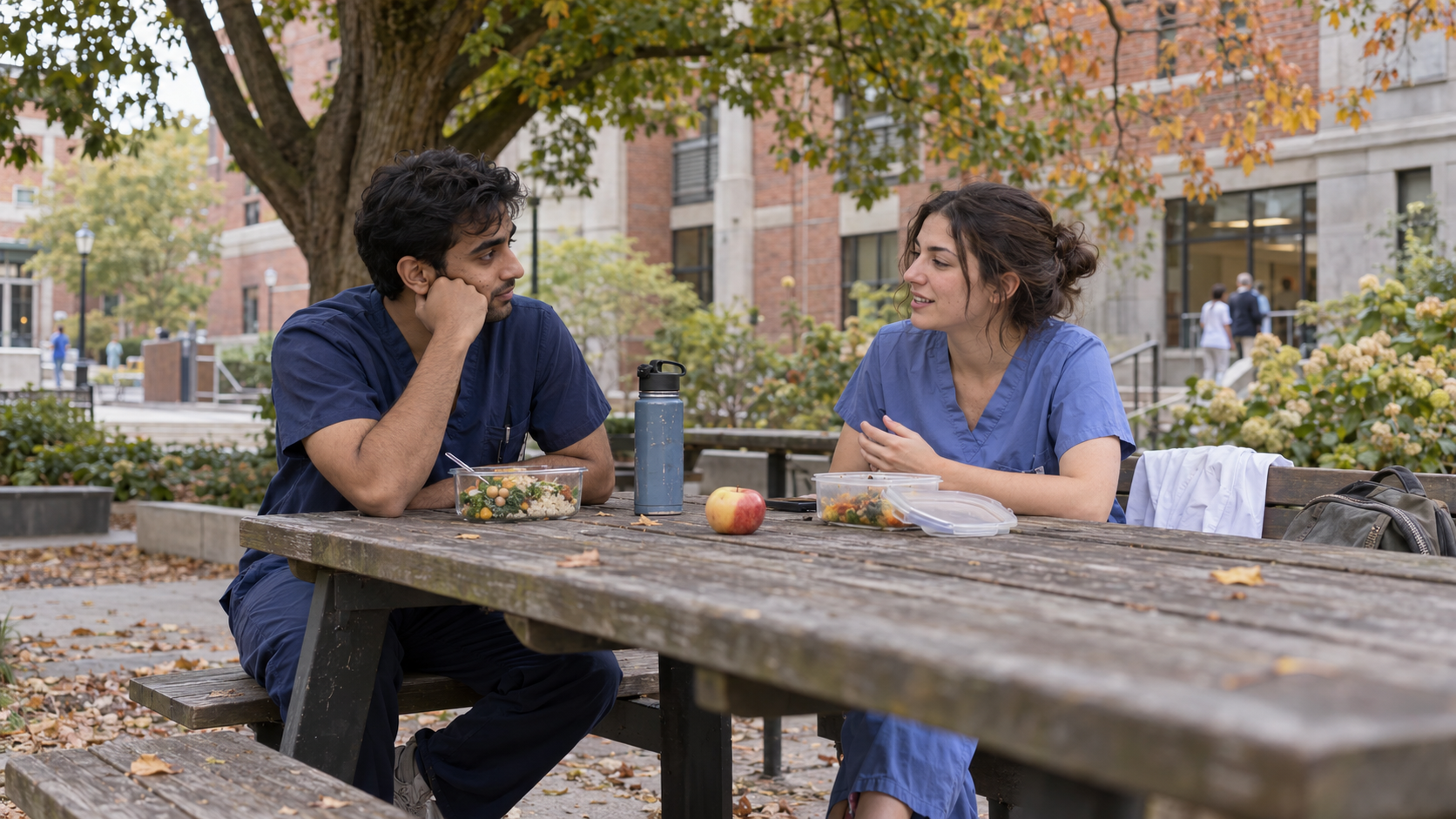
Medical school runs on deferral. You defer income, sleep, weekends, and sometimes relationships. Residency defers more.
Many of us won't put real money into a retirement account until our thirties. There is a second retirement plan, and it can't wait that long. It's your health.
You don't want to reach retirement arthritic and bed-bound after thirty years of taking care of everyone else. You want to travel the world with the love of your life. Run with your grandchildren. Play golf with your friends.
Health compounds the way money does. Small deposits made early and daily beat large deposits made late. It's dollar-cost averaging for the body.
The habits you build on rotations are the ones you'll carry into residency and practice. You'll also spend your career counseling patients on these same four habits. Patients notice whether you keep them.
One who SEES well trains well, and retires well: Sleep, Eat, Exercise, Socialize.
Sleep well
Adults need at least 7 hours a night. Don't charge your phone halfway overnight and expect it to last through afternoon clinic.
For a student, sleep isn't time taken from studying. It's part of studying. The brain consolidates the day's learning during sleep, and one night without it measurably impairs the hippocampus's ability to form new memories.
The all-nighter before a shelf exam buys reading time at the cost of remembering what you read.
Chronic short sleep is also linked to hypertension, insulin resistance and type 2 diabetes, weight gain, cardiovascular disease, depression, and weaker immunity. In one study, people sleeping under 6 hours were about four times as likely to catch a cold after exposure to rhinovirus.
Sleep debt shows up in your choices, too. You can know the healthy option and still not pick it. A tired brain reaches for the vending machine and skips the workout.
On rotations you won't always get 7 hours. Protect them where you can: the night before an exam, the night after call. Keep caffeine to the morning, and treat a nap before a night shift as part of the job.
Eat well
Eat good food. Avoid bad food. Give your body regular breaks from eating.
We become what we eat.
Eat good food
You know the list: vegetables, fruits, nuts, olive oil, fatty fish. It's the core of the Mediterranean diet, which has the best randomized evidence of any eating pattern for preventing heart attack and stroke.
I want to focus on vegetables and fruits, because that's where a small daily change does the most. Only about 1 in 10 US adults eats enough vegetables, and about 1 in 8 eats enough fruit. The 2025–2030 Dietary Guidelines for Americans call for about three servings of vegetables and two of fruit a day on a 2,000-calorie diet.
Plants deliver three things the rest of the American diet rarely does.
Fiber. It keeps your bowels moving, which matters when you sit twelve hours a day. It also feeds the gut microbiome, which a fast-growing literature links to metabolic, immune, and mental health.
Nitrate. Leafy greens and beets are rich in it. Bacteria on your tongue reduce it to nitrite, and your body converts nitrite to nitric oxide, the vasodilator you met in pharmacology. Endothelial nitric oxide production falls with age, so this dietary route matters more as you get older.
Antioxidants. Breathing keeps us alive, but oxidative metabolism makes reactive oxygen species that damage proteins, lipids, and DNA. That damage is one of several mechanisms thought to drive aging. Diets rich in fruits and vegetables are consistently linked to less cardiovascular disease and lower mortality.
Antioxidant pills are another story. In trials they haven't reproduced that benefit, and beta-carotene supplements increased lung cancer in smokers. The benefit seems to live in the whole food, not the extracted molecule.
So why do so few of us eat enough of them? Friction and willpower. The wards will drain your willpower before noon.
So remove the friction. The easiest hack I know: blend 1 cup of fruit with 2 to 3 cups of vegetables and drink it every day. Do it early, while willpower is still high.
My go-to green smoothie is spring mix, honey yogurt, and ice, with berries if I have them. Here's another recipe for a “green goddess” [add link]. Blend it the night before and it survives a 4:30 a.m. pre-rounding start.
Ever watch cows and giraffes chew all day? They have to. You're the species that built the blender and a rocket to Mars. You can spend one minute blending.
Blending breaks open plant cell walls, which makes some nutrients, like carotenoids, easier to absorb. Unlike juicing, it keeps the fiber. Keep it mostly vegetables, and go easy on juice and added sugar.
Avoid bad food
The substance we overuse most isn't cocaine, alcohol, or marijuana. It's ultra-processed food. We keep going back to it while knowing exactly what it does to us.
Taken together, poor diet is responsible for more deaths worldwide than any other risk, tobacco included. The Global Burden of Disease study counted about 11 million diet-related deaths in 2017, led by too much sodium and too few whole grains and fruits.
Here's the irony: bad food tastes good. For most of human history calories were scarce, and a brain that craved dense, sweet, salty food helped us survive. The industrial and technological revolutions turned scarcity into abundance faster than evolution could adjust.
So the wiring now works against us, and training is an obesogenic environment. Free pizza at the lunch lecture. The vending machine outside the call room. Cafeteria fries at 2 a.m.
Bad food falls into five groups: high sodium, red and processed meat, ultra-processed food, high-AGE food, and high-glycemic food.
High sodium. I tell my patients: you don't swell from the water you drink. You swell from last night's takeout.
Sodium holds water in the extracellular space. That's the puffy eyelids and sock-line edema the morning after a salty meal. Over years, the same load raises blood pressure, stiffens arteries, and strains the heart and kidneys.
On the wards you'll meet it as the heart failure patient readmitted after a holiday ham. The guideline limit is under 2,300 mg a day. The average American eats about 3,400 mg, and more than 70% of it is added by food manufacturers and restaurants, not the salt shaker.
Red and processed meat. Red meat is high in saturated fat, which raises LDL cholesterol. Higher intake is linked to heart disease, type 2 diabetes, and colorectal cancer. The World Health Organization's cancer agency classifies processed meat (bacon, ham, hot dogs, deli meat) as carcinogenic to humans, and red meat as probably carcinogenic.
Ultra-processed food. It's stripped of fiber, nitrate, antioxidants, vitamins, and minerals, then loaded with sodium, added sugar, and additives. It also tends to be high in AGEs.
In an inpatient trial at the NIH, people could eat as much as they wanted. On ultra-processed meals they ate about 500 more calories a day than on unprocessed meals matched plate for plate for calories, sugar, fat, fiber, and sodium. They gained about 2 pounds in two weeks.
High-AGE food. Less known, but more common. AGEs, or advanced glycation end products, form when sugars react nonenzymatically with proteins, lipids, and nucleic acids.
You already know an early glycation product: hemoglobin A1c. Over time, early products like it rearrange into AGEs, which cross-link collagen, stiffen vessels, and signal through their receptor, RAGE, to drive oxidative stress and inflammation. Diabetes is a state of accelerated AGE formation, which is part of how it damages kidneys, retinas, and nerves.
We also eat AGEs. Dry, high-heat cooking (grilling, broiling, roasting, frying) makes far more of them than moist, gentle cooking (poaching, stewing, steaming). Fried steak carries several times as much as poached chicken. Think donuts, fries, and fried chicken.
Marinating meat in lemon juice or vinegar before cooking cuts AGE formation. Uribarri and colleagues have published the AGE content of more than 500 common foods [add link]. Note where the processed ones land.
One caveat for the evidence-minded: most human data on dietary AGEs come from small trials and observational studies. Plausible, not settled.
A rule of thumb: if a meal sends you into a food coma, it was probably too big, too refined, or too fried. The heavy lamb biryani lunch. The free pizza before the 1 p.m. lecture.
High-glycemic food. Sugar, sweets, soft drinks, white bread, white rice, potatoes. They spike glucose and insulin. A steady diet of them promotes visceral fat, insulin resistance, and metabolic syndrome, which raises the risk of type 2 diabetes, hypertension, and stroke.
Small amounts, occasionally, are fine. The trouble is that bad habits compound too. They reinforce one another until you're left with an unhealthy cluster: bad food, bad sleep, no exercise.
Tobacco and alcohol. Don't smoke or vape. Drink less, or not at all. The 2025–2030 Dietary Guidelines dropped the old limits of one or two drinks a day and now simply advise drinking less.
A 2025 Surgeon General's advisory named alcohol the third leading preventable cause of cancer in the US, after tobacco and obesity. Worth remembering at the post-shelf celebration.
Fasting
When the cells are not eating, they are healing.
Japanese cell biologist Yoshinori Ohsumi won the 2016 Nobel Prize in Physiology or Medicine for discovering the mechanisms of autophagy. Autophagy is how cells break down and recycle their own worn-out parts, and fasting turns it up.
In many animal models, fasting and calorie restriction slow aging and extend lifespan. The human evidence is more modest. Trials of time-restricted eating show weight loss similar to ordinary calorie restriction.
In one small trial, men with prediabetes ate all their meals within a 6-hour window that ended before 3 p.m. Their insulin sensitivity and blood pressure improved, without weight loss.
Eat only when the sun is out. My own rule is nothing after 6 p.m., then the first meal at 10 a.m. or noon the next day. That's a 16- to 18-hour fast.
Your surgery rotation will laugh at that schedule. Keep the principle anyway: a consistent window, most of your calories early, and as few 2 a.m. vending-machine dinners as you can manage.
Skip fasting altogether if you're pregnant, take insulin or a sulfonylurea, or have a history of disordered eating.
Exercise well
Each form of exercise does something the others don't.
Strength. Weights and calisthenics build and preserve muscle and bone.
Aerobic. Running, cycling, and swimming condition the heart, lungs, and vessels.
Yoga. It works tendons, ligaments, and joints. A lifetime of impact compresses them, and yoga moves them the other way. The American College of Physicians recommends it among the initial nonpharmacologic treatments for chronic low back pain, and it's a natural segue into meditation.
Your body is like a house. It needs plumbing, but it also needs woodwork, brickwork, and wiring.
The Physical Activity Guidelines for Americans call for 150 to 300 minutes a week of moderate aerobic activity, or 75 to 150 minutes of vigorous activity, plus muscle strengthening on at least 2 days.
You'll counsel patients on these numbers for the rest of your career. Practice them on yourself first. Since the 2018 update, activity no longer has to come in 10-minute bouts to count, so the stairs to the eighth-floor consult count.
Exercise is also an underused study aid. It improves sleep and mood, and in trials it reduces depressive symptoms.
Add 15 minutes of meditation to your day. All day your mind runs errands: the next patient, the next page, the next exam. Meditation gives it a break and a little space to reset.
It isn't about emptying your mind. You notice where your attention has gone and bring it back, usually to the breath. Every return is a rep.
Think of it as practice for your mind's brakes. Anxiety and rumination are what happens when the brakes don't hold. In imaging studies, experienced meditators show less activity in the default mode network, the brain's circuitry for mind-wandering and self-referential thought.
If 15 minutes feels impossible, start with five before a shift.
Socialize well
Make room for at least one meaningful social connection a week. Humans evolved as tribal animals because it paid off. United we stand, divided we fall. Don't fight millions of years of evolutionary programming. Use it.
The data are hard to ignore. The 2023 US Surgeon General's advisory on loneliness compared the mortality risk of social disconnection to smoking up to 15 cigarettes a day. Poor social connection is also linked to heart disease, stroke, dementia, depression, and anxiety.
Chronic stress shows up in the body: tension headaches, functional dyspepsia, chronic back pain, widespread pain. You'll learn to recognize these presentations in patients. Recognize them in yourself first.
Medical school is quietly isolating. Twelve hours in a library carrel with headphones on isn't social time. Neither is the class group chat.
More than 1 in 4 medical students report depressive symptoms. If you're struggling, use your school's counseling services. Getting help is part of the job, not a failure at it.
The best move is to combine socializing with exercise: tennis, badminton, pickleball, a pickup game, a weekend ride with classmates.
In the Copenhagen City Heart Study, tennis players lived about 9.7 years longer than sedentary peers, and badminton players about 6.2. Joggers gained 3.2 years and gym-goers 1.5.
The study was observational, so tennis players surely differ in other ways. But the authors noted that the sports with the most social interaction were linked to the longest lives. That's reason enough to find a tennis partner.
Start now
These are the four pillars of health. A building needs all four of its foundations. Remove one and the whole structure comes down.
Some things you can't change: your genes, your preexisting conditions. Others you can. The Serenity Prayer asks for the wisdom to know the difference.
You already know the difference. Why not start NOW?
Aging is an irreversible process, but it is a process with momentum, and momentum can change. Yours is being set right now, somewhere between the library and the wards.
One who SEES well trains well, ages slowly, and retires well.
Thank you for reading. If this helped, like, follow, or share it, especially with the classmate who's been living on vending-machine dinners. We look forward to sharing more with you.
Sources
Sleep
- Watson NF et al. Recommended amount of sleep for a healthy adult (AASM and SRS consensus). Sleep, 2015.
- Yoo SS et al. A deficit in the ability to form new human memories without sleep. Nature Neuroscience, 2007.
- Prather AA et al. Behaviorally assessed sleep and susceptibility to the common cold. Sleep, 2015.
Eat
- Dietary Guidelines for Americans, 2025–2030. USDA and HHS, January 2026.
- Lee SH et al. Adults meeting fruit and vegetable intake recommendations, United States, 2019. MMWR, 2022.
- Estruch R et al. Primary prevention of cardiovascular disease with a Mediterranean diet supplemented with extra-virgin olive oil or nuts (PREDIMED). NEJM, 2018.
- Lundberg JO et al. The nitrate–nitrite–nitric oxide pathway in physiology and therapeutics. Nature Reviews Drug Discovery, 2008.
- ATBC Cancer Prevention Study Group (NEJM, 1994) and Omenn GS et al., CARET (NEJM, 1996): beta-carotene and lung cancer in smokers.
- GBD 2017 Diet Collaborators. Health effects of dietary risks in 195 countries, 1990–2017. Lancet, 2019.
- FDA. Voluntary sodium reduction goals, Edition 2 (average intake and sources of sodium). 2024.
- Bouvard V et al. Carcinogenicity of consumption of red and processed meat (IARC). Lancet Oncology, 2015.
- Hall KD et al. Ultra-processed diets cause excess calorie intake and weight gain. Cell Metabolism, 2019.
- Uribarri J et al. Advanced glycation end products in foods and a practical guide to their reduction in the diet. Journal of the American Dietetic Association, 2010.
- US Surgeon General. Alcohol and Cancer Risk (advisory). January 2025.
- Sutton EF et al. Early time-restricted feeding improves insulin sensitivity, blood pressure, and oxidative stress even without weight loss in men with prediabetes. Cell Metabolism, 2018.
- Liu D et al. Calorie restriction with or without time-restricted eating in weight loss. NEJM, 2022.
Exercise
- Physical Activity Guidelines for Americans, 2nd edition. HHS, 2018.
- Qaseem A et al. Noninvasive treatments for acute, subacute, and chronic low back pain (ACP guideline). Annals of Internal Medicine, 2017.
- Noetel M et al. Effect of exercise for depression: systematic review and network meta-analysis of randomised controlled trials. BMJ, 2024.
- Brewer JA et al. Meditation experience is associated with differences in default mode network activity and connectivity. PNAS, 2011.
Socialize
- US Surgeon General. Our Epidemic of Loneliness and Isolation (advisory). 2023.
- Rotenstein LS et al. Prevalence of depression, depressive symptoms, and suicidal ideation among medical students. JAMA, 2016.
- Schnohr P et al. Various leisure-time physical activities associated with widely divergent life expectancies: the Copenhagen City Heart Study. Mayo Clinic Proceedings, 2018.