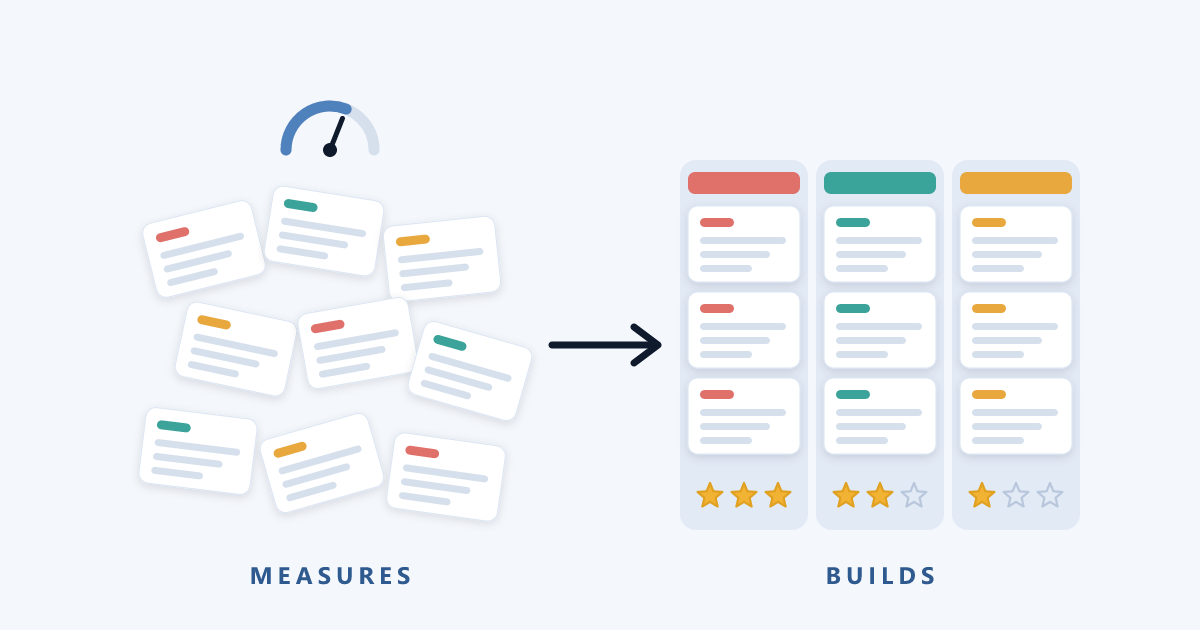
Your Qbank Measures. Your Study System Builds.
How to turn questions into lasting shelf exam mastery

Most students begin preparing for a shelf exam the same way.
They open a Qbank, start answering questions, read the explanations, and keep going. The percentage correct becomes their measure of progress. The more questions they complete, the more prepared they hope to feel.
And to a point, this works.
Every question is an opportunity to retrieve knowledge, encounter a new clinical presentation, and learn from an explanation. A good Qbank is one of the most powerful tools a medical student has.
But there is a problem with relying on questions alone.
You can answer hundreds of questions, recognize familiar explanations, and still struggle when the same concept appears in a different clinical vignette. You may remember the answer to a question without understanding why it was correct. You may know a diagnosis but fail to distinguish it from the two alternatives sitting beside it.
The problem is not that you have done too few questions.
It is that answering questions and building knowledge are related, but they are not the same thing.
A Qbank can show you what you know today. Your study system determines how well you understand it, organize it, and remember it when you need it again.
The exam is built on distinctions
Shelf exams and Step 2 CK rarely reward memorizing a diagnosis in isolation.
They reward recognizing a diagnosis in context, identifying the finding that matters, and distinguishing it from plausible alternatives.
A patient presents with fever, a rash, and joint pain. Several diagnoses fit. One laboratory result changes the interpretation. One feature of the timeline makes the difference. One detail in the question stem tells you which answer is best.
The knowledge you need is not simply the name of the disease.
It is the relationship between the disease and the conditions that resemble it.
For every important topic, learn to ask three questions:
What are the look-alikes?
Which other diagnoses could reasonably appear beside this one in the answer choices?
What separates them?
Which clinical finding, laboratory result, time course, or mechanism helps distinguish them?
Where is the trap?
What makes the wrong answer attractive? What detail would a student who only partially understands the topic overlook?
These questions turn a diagnosis into something more useful: a framework for recognizing it in an unfamiliar patient.
You do not need to reduce every disease to one distinguishing fact. Clinical medicine is more complex than that. But learning the important distinctions gives your knowledge structure and makes it easier to retrieve under pressure.
Knowledge needs somewhere to go
In a classic 1969 experiment, Gordon Bower and colleagues studied how the organization of information affects memory. Participants recalled categorized word lists more effectively when the information was presented in an organized structure rather than randomly.
The lesson is not that all learning must be organized before it begins.
It is that information becomes easier to retrieve when it has meaningful relationships to other information.
Medical knowledge works the same way.
A fact about heart failure becomes more useful when you understand how it relates to other causes of dyspnea. A laboratory pattern becomes more memorable when you know which competing diagnoses produce similar results. A treatment becomes easier to recall when you understand why it works and when it should not be used.
The goal is not to memorize isolated facts.
The goal is to build a mental structure in which facts support, distinguish, and reinforce one another.
This is where deliberate study can make a difference.
Instead of moving through questions and hoping the explanations eventually come together, take the time to organize what you learn around the clinical concepts that matter.
Why studying similar conditions together helps
There is another important principle in learning science: interleaving.
Rather than studying one category repeatedly before moving to another, interleaving mixes related categories so that you must identify which one applies.
A 2019 meta-analysis by Brunmair and Richter examined 59 studies of interleaved learning. Its findings suggest that interleaving can improve learning, particularly when students need to distinguish between similar categories.
That is especially relevant to medical education.
Studying two similar causes of anemia side by side forces you to identify what separates them. Comparing different causes of jaundice helps you understand which laboratory patterns matter. Working through similar presentations of abdominal pain trains you to recognize the clinical features that change the differential diagnosis.
But there is an important distinction.
Mixing unrelated topics and mixing similar topics are not necessarily the same learning experience. And the best sequence may depend on how much you already know.
For a completely unfamiliar topic, some focused study may be necessary before meaningful comparison becomes possible. Once you have a basic understanding, mixing related concepts can strengthen discrimination. Later, mixed questions across entire subjects help you retrieve the right knowledge without being told which topic you are studying.
The goal is not to eliminate random practice.
It is to use focused and mixed practice at the stages where each is most useful.
A simple cycle for building knowledge
A practical study system does not need to be complicated.
It needs to connect understanding, practice, and memory.
Step 1: Understand the concept
Begin with the clinical idea.
Read the topic with a specific purpose: understand the mechanism, presentation, diagnosis, and management well enough to distinguish it from related conditions.
Do not try to memorize every detail on the first pass.
Ask yourself why the disease produces its characteristic findings. Understand what changes the diagnosis and what changes the next step in management.
When the logic is clear, the details have somewhere to attach.
Step 2: Practice the distinction
Immediately after learning the concept, answer a few focused questions.
One to three questions may be enough to begin testing whether you understood the idea. The exact number matters less than the quality of the practice.
Do not simply look for the correct answer.
Explain why it is correct, why the closest alternative is wrong, and which finding would change your decision.
If you miss the question, identify what failed.
Was it a missing fact? A misunderstanding of the mechanism? Failure to recognize a key finding? Confusion between two similar diagnoses?
Each type of error requires a different response.
Step 3: Return to the knowledge
Understanding something today does not guarantee that you will remember it next month.
Memory requires retrieval over time.
After completing a topic, return to the important concepts and test yourself again. Review the distinctions you missed. Revisit the facts that were difficult to retrieve. Increase the interval between reviews as your knowledge becomes more secure.
This is the principle of spaced retrieval: bring knowledge back after time has passed, rather than repeatedly reviewing it while it is still fresh.
The cycle is simple:
Understand the concept. Practice using it. Retrieve it again later.
What the research tells us about remembering
The evidence for retrieval practice is strong, and it holds up in medical education.
In a 2009 randomized study by Larsen and colleagues, medical residents remembered more six months later of the material they had been repeatedly tested on, with feedback, than of the material they had repeatedly restudied. Final test scores were 39% for the tested material compared with 26% for the restudied material.
The implication is important.
Reading an explanation can help you understand a concept. But retrieving that concept from memory, receiving feedback, and returning to it later can make the knowledge more durable.
This is why questions should not be treated merely as a score-producing activity.
They are opportunities to strengthen memory.
And this is why the explanations matter. The most valuable question is not necessarily the one you answered incorrectly. It may be the one you answered correctly for the wrong reason.
A lucky guess can raise your percentage correct without improving your understanding.
When you answer a question, make sure you can explain the reasoning—not just recognize the answer.
Where UWorld and AMBOSS fit
A large Qbank is not the enemy of a structured study system.
It is an essential part of one.
Qbanks provide something that textbooks and focused review cannot fully reproduce: repeated exposure to clinical vignettes in which you must identify the relevant information, retrieve knowledge, and make a decision.
They help you learn, test your understanding, and prepare for the conditions of the actual exam.
They also expose gaps you did not know existed.
The key is what you do with those gaps.
When you miss a question, do not simply read the explanation and move on. Identify the underlying concept. Connect it to the diagnoses or management decisions that resemble it. Return to it later.
When you answer correctly, do not assume the concept is mastered. Ask whether you could recognize it in a different presentation.
And as your knowledge develops, use mixed blocks to practice retrieving the right concept without knowing the subject in advance.
A Qbank can teach extremely well when it is used deliberately.
But completing a certain number of questions is not, by itself, a complete measure of learning.
Your percentage correct tells you how you performed on those questions. It does not fully tell you how durable your knowledge is, how well you understand the underlying concepts, or whether you can transfer that knowledge to an unfamiliar clinical problem.
That is why your study system matters.
From shelf exams to Step 2 CK
Your shelf exams are not isolated events.
The knowledge you build during medicine, surgery, pediatrics, obstetrics and gynecology, psychiatry, and the other clerkships becomes the foundation for Step 2 CK.
If you study each shelf as a separate sprint, much of that knowledge may fade before you need it again.
If you organize the important concepts and revisit them over time, each clerkship can reinforce the next.
You do not need to start from zero every time you prepare for a new exam.
You need to maintain and strengthen the knowledge you have already built.
Spaced review helps make that possible. Mixed practice helps you retrieve it across subjects. Clinical questions help you apply it to new presentations.
The result is not simply preparation for the next shelf.
It is cumulative preparation for Step 2 CK.
Putting it into practice
Full disclosure: From Shelf to CK and Pradis are my own products. I designed them around the principles described in this article.
The approach is straightforward.
You study a concept, practice it with focused questions, and return to it through spaced review. Once you have built a foundation across the topics, you use broader mixed practice to strengthen retrieval and clinical discrimination.
In Pradis, a question earns mastery after three confident correct answers on different days, with progressively longer intervals between reviews.
Three is not a number established by a clinical trial. It is a practical rule designed to encourage repeated retrieval rather than a single successful attempt.
And a star is not proof of mastery.
You can remember the wording of a question without understanding the concept. You can answer correctly while remaining uncertain about why the alternatives are wrong.
That is why confidence and explanation matter.
When you earn a star, make sure you can explain the concept in your own words and recognize it in a different clinical context.
The system is intended to help you build a foundation, not replace the judgment required to determine whether you truly understand something.
The goal is not more questions. It is more durable knowledge.
There is no single study sequence that works perfectly for every student or every subject.
Some students need more focused learning before they begin mixed practice. Others already have a strong foundation and benefit from starting with questions. Most will use both approaches at different points in their preparation.
What matters is that studying becomes more than a sequence of completed tasks.
A question should help you understand something. An explanation should clarify something. A missed concept should return before you forget it completely. A correct answer should become knowledge you can use again.
The number of questions you complete is useful information.
But the knowledge you retain, organize, and apply is what ultimately matters.
Learn the concept. Practice the distinction. Retrieve it again.
That is how questions become knowledge—and how knowledge becomes lasting preparation for the shelf exams and Step 2 CK.
From Shelf to CK and Pradis are the author’s own products. The study approach described here reflects the author’s educational philosophy and product design; the article does not establish that Pradis produces better exam outcomes than other Qbanks or study systems.